
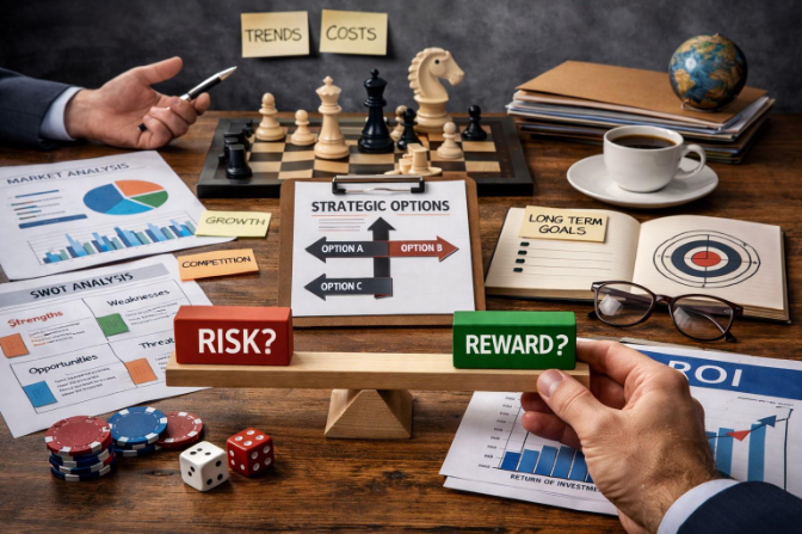
Listen to an AI audio recording of this newsletter
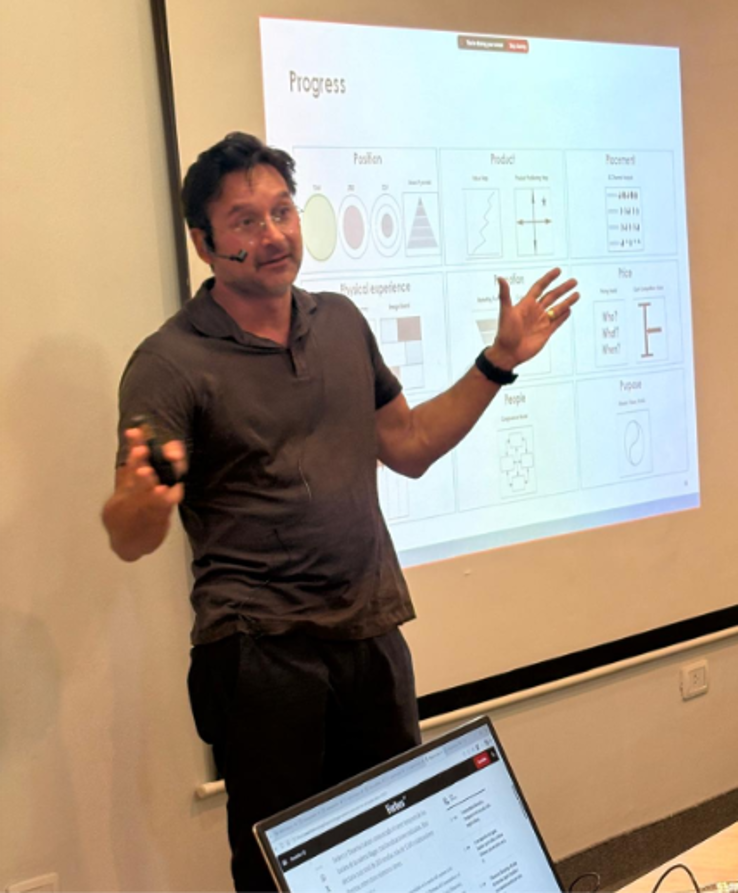
I’m writing this while preparing to speak with a group of marketing master’s students at Universidad Americana in Paraguay about strategy, growth, and how organizations decide where to place their bets.
Just before noon, I step into the hotel van, and we wind our way through the dense, humid heat of Asunción. By mid-afternoon, 30 university students will be gathered in a classroom where we’ll spend the next three days, eight hours each day, working through some of strategy’s most important ideas.
It’s a different audience from the one I usually work with. Most days my conversations are with chief strategy officers, transformation leaders, and senior executives inside multi-billion-dollar companies. But the questions we explore together are exactly the same:
- How do you choose the right opportunities?
- How do you avoid working incredibly hard on the wrong things?
- How do organizations stay coherent as they scale?
Those questions were top of mind after my recent Strategy at Scale podcast with Brett Hickey, founder of Star Mountain Capital. Brett has seen thousands of companies up close across industries, economic cycles, and stages of growth, and has invested in hundreds of them. What struck me during our conversation wasn’t a new framework. It was something more fundamental.
Scale doesn’t forgive ambiguity.
In small organizations, a lot of things “just work.” People coordinate through instinct. Founders compensate for missing systems. Favorable conditions hide weak pricing, unclear positioning, or fragile assumptions. But as organizations grow, those gaps stop being manageable. They become structural, and they compound.
That’s why, at scale, strategy can’t live only in the CEO’s head or appear once a year during planning. It needs a home. It needs ownership. It needs a system.
That is the real role of a strategy office.
Strategy as a Compass
Most organizations don’t lack activity. They lack direction.
Teams are busy. Initiatives are underway. Dashboards are full. But ask a simple question, “What are we optimizing for?” and you’ll often get very different answers depending on who you ask.
Before any framework or planning process can work, an organization needs something more basic.
It needs a compass.
A strategy office serves that role first. Its job is to make the organization’s positioning explicit: where we choose to play, where we refuse to play, and why those choices matter. Without that clarity, activity quickly outpaces alignment.
This was a theme that surfaced repeatedly in my conversation with Brett. Leaders often focus on execution, talent, and operational improvement while under-investing in understanding the market itself.
When the terrain is wrong, execution doesn’t compound. It dissipates.
At small scale, effort can hide that problem. At larger scale, it becomes impossible to ignore.
The strategy office keeps the organization oriented toward arenas where effort actually matters. Markets where real demand exists and structural advantages can form.
Without that compass, organizations can spend years moving quickly in the wrong direction.
Strategy as a Plan
A compass gives direction. A plan turns direction into commitment.
One of the most common failure modes in scaled organizations is treating strategy as aspiration rather than choice. Everything sounds important. Everything gets funded a little. Tradeoffs remain implicit.
The strategy office exists to make choices explicit and durable.
A real plan answers uncomfortable questions:
- Which opportunities deserve disproportionate investment?
- Which initiatives are experiments, and which are scale bets?
- What sequencing matters, and what must wait?
Brett talked about optimizing for higher-probability outcomes. That idea matters because it shifts focus from activity to odds. A good plan does not guarantee success, but it dramatically improves the likelihood that effort translates into results.
The strategy office institutionalizes that discipline.
Strategy as a Process
Most organizations don’t fail because of one bad decision. They fail because they make thousands of small ones without a shared logic.
In early stages, coordination is informal. People just know what matters. As complexity increases, that shared understanding erodes. Incentives start shaping behavior more than intention.
This is where strategy becomes a process, not an event.
A strategy office designs and maintains that process. It ensures that decisions about investments, pricing, partnerships, talent, and innovation flow through a common set of questions:
- Does this reinforce our positioning?
- Does it strengthen or dilute advantage?
- Will it hold as complexity increases?
This connects directly to a company’s policies, processes, and performance. Culture alone can’t do this work. Alignment does not come from slogans. It comes from systems.
As Brett put it, it is easier to act like an owner if you actually are one.
Strategy as Intelligence
Finally, a strategy office serves as the organization’s intelligence function.
Brett highlighted a common blind spot: leaders often focus on the immediate customer, while demand risk emerges further upstream. Revenue risk doesn’t announce itself neatly. By the time it’s visible internally, the real signal has already passed.
The strategy office scans for those signals.
This is where patterns and proof matter. Not anecdotes. Not hype. Evidence across markets, customers, competitors, and capital flows. Early indicators that assumptions may no longer hold.
This kind of intelligence is not about prediction. It is about preparedness.
Try the Strategy Yourself
When I speak to students in Paraguay, I won’t start with theory. I’ll start with a decision.
Each student will bring one idea and test whether it actually deserves years of effort. Not whether it sounds exciting, but whether its structure gives that effort a chance to compound.
The same discipline applies inside large organizations.
That’s why I use a simple but demanding Opportunity Assessment built around eight lenses: market size, tailwinds, dependency risk, customer lifetime value, proven demand, customer dissatisfaction, competitive structure, and differentiation.
For each lens, the goal is not to be clever. It is to be honest.
What evidence do you actually have? Where are you guessing? What would need to be true for this to work at scale?
Why This Matters Now
Large organizations don’t lack smart people or ambition. What they often lack is a dedicated function responsible for coherence across initiatives, across time, and across leadership changes.
That is the quiet power of a strategy office.
Not as a staff function. Not as a slide factory. But as the steward of the organization’s long-term logic.
At its best, a strategy office plays four essential roles:
- It provides the compass that clarifies where the organization chooses to play.
- It helps leaders build the plan that turns direction into real commitments.
- It establishes the process that keeps decisions aligned as complexity grows.
- And it develops the intelligence that detects changes in the terrain before they become crises.
Scale doesn’t reward activity. It rewards businesses deliberately designed to hold as complexity increases.
As your organization scales, are your results coming from deliberate design or from conditions that may not last?
To learn more about strategy assessment and making the right bets, join Outthinker.com today.