
Listen to an AI audio recording of this newsletter
At the recent Outthinker Summit in Miami, our coaches compared notes from the companies they advise, and a clear pattern emerged. The power of the Outthinker 9 Ps framework is not just that it gives leaders nine separate boxes to fill out.
It expands the aperture of possibility.
It pushes leaders to look beyond the obvious answer and discover what I call the fourth option: a new way to create value that competitors have not considered.
The 9 Ps are a simple checklist for where a company can create advantage: Position, Product, Promotion, Pricing, People, Physical Experience, Process, Place, and Partnerships.
Most companies tend to focus on only one or two of these areas. Sales teams gravitate toward Promotion. Product teams focus on Product. HR leaders look at People. But breakthrough growth often comes from finding a new way to compete in a place others are ignoring.
That is why the 9 Ps matter. In the hands of a good coach or facilitator, they can force leaders to step back and look at the whole business. Where could we serve a different customer? Change the way we price? Rethink the experience? Build a partnership no one else has considered?
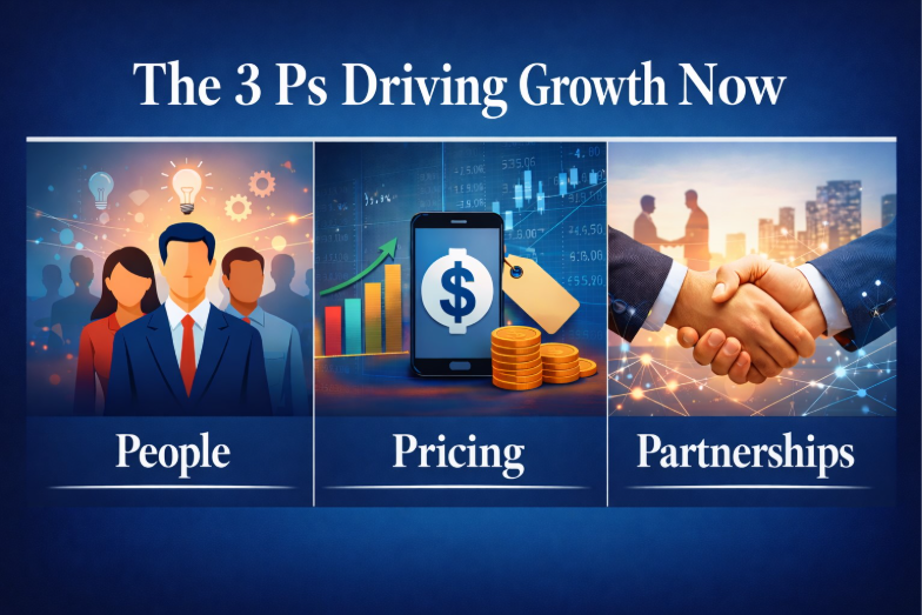
Every company should consider all nine. But after listening to the stories shared by the coaches, three Ps stood out as especially timely and powerful right now: People, Pricing, and Partnerships.
These were the areas where companies were not simply improving execution. They were redefining how they compete.
People
The first P that stood out at the Miami Summit was People.
Too often, leaders think about people as an HR issue: hiring, training, and culture. But the companies creating the strongest advantage are using People as strategy. They are designing their organizations, incentives, and talent models in ways competitors cannot easily copy.
Sharn Rayner, founder of Two Tides Consulting, shared a powerful example from Cause and FX, a film production and visual effects studio.
The company realized that its greatest advantage was not simply the technology it provided, but the way it organized its people around clients. Rather than operating in traditional functional silos, Cause and FX built small, multidisciplinary teams that combined technical, creative, and strategic expertise around each client challenge.
That structure changed the client experience. Customers no longer had to navigate multiple departments, wait for handoffs, or repeat the same problem to different people. They worked with one integrated team that could move faster, connect ideas across functions, and solve more complex problems.
The shift also changed the economics of the business. Because the teams were more collaborative and more deeply embedded with clients, Cause and FX built stronger relationships, identified more opportunities for additional work, and increased repeat business.
As Sharn explained, the company was no longer simply competing on the quality of its work. It was competing on the quality of its people model, and that became a meaningful source of differentiation.
In a world where technology and products are increasingly easy to imitate, the way you organize and empower people may be one of the hardest advantages to copy.
Pricing
The second P that emerged from the Miami Summit was Pricing.
Most companies still price the way their industry has always priced: by the hour, by the project, by the unit. But some of the strongest opportunities come from changing the pricing model itself.
Adam Siegel, CEO of Visage Growth Partners, shared the example of an industrial services company that traditionally priced its work by the hour, like nearly every competitor in the industry.
The company asked a different question: what if we priced based on the value created instead of the labor provided?
It began moving toward a usage-based model tied to the customer’s output. Instead of paying for unpredictable maintenance calls, customers paid in proportion to the amount of business flowing through their operations.
That shift did more than change the price. In many cases, it allowed the expense to be treated as an operating expense rather than a capital expense, making it easier for customers to approve internally.
The new model also aligned the company’s incentives with the customer’s success and differentiated it from competitors still using the industry’s traditional pricing approach.
As Adam explained, the response from mid-tier operators has been extremely positive.
Pricing is often treated as the last decision a company makes. In reality, it can be one of the most strategic. The right pricing model does not simply capture value. It changes how customers perceive the value you create.
Partnerships
The third P that stood out was Partnerships.
Many companies still think of partnerships as a side activity. The strongest companies use them to expand what they can offer, accelerate growth, and create advantages they could never build alone.
Adam offered that one client’s biggest breakthrough did not come from selling more of its core service. It came from building a partnership with a manufacturer in its industry.
On its own, the company maintained equipment. The manufacturer sold that equipment. Together, they created a complete lifecycle offering: one company sold the product, the other maintained and serviced it over time.
That changed how customers viewed the business. Instead of seeing it as a transactional vendor, they saw it as part of a larger, integrated solution.
The lesson is clear: the best partnerships do not simply help a company sell more. They help a company become more valuable.
The Other 6 Ps Still Matter
The other six Ps remain essential because they often create the context in which People, Pricing, and Partnerships can succeed.
Position
Position asks who you serve, what job they are trying to get done, and what you want your company to mean in their mind. The strongest companies focus on the customers with the greatest unmet need and the highest long-term value.
Product
Product is not just what you sell. It is how you solve the customer’s problem in a way competitors do not. Tesla succeeded by making electric vehicles feel aspirational rather than practical.
Promotion
Promotion is about finding a message and a channel that competitors overlook. Salesforce did not market itself as better software. It promoted itself as “No Software,” making the old model feel obsolete.
Leslie DaCruz, founder and CEO of Stradeation, shared an example from his work with one of the world’s most iconic entertainment companies. Rather than treating film, streaming, theme parks, and merchandise as separate businesses, the company turns each new story into a promotional flywheel. A character introduced in one channel increases demand across all the others, creating far more value than any single product could create on its own.
Physical Experience
Physical Experience includes everything customers see and feel. The Ritz-Carlton wins not simply because of its rooms, but because every detail, from the lobby scent to the service, feels intentional and premium. Apple similarly turned packaging and store design into part of the product itself.
Process
Process is often invisible but powerful. Google’s search process created a better answer than competitors, while Tesla’s decision to build more of its components in-house gave it greater control and speed.
Place
Place is where and how customers access your offering. Walmart grew by going where competitors would not: rural America.
Why the 9 Ps Matter Now
The companies that succeed over the next decade will not be the ones that simply optimize what already exists. They will be the ones that continually reinvent how they create value.
That is what the 9 Ps make possible. They help leaders move beyond generic discussions of innovation and pinpoint where they can become different in ways that customers value and competitors resist copying.
At the Miami Summit, the message was clear: Outthinker’s coaches are not using the 9 Ps as an abstract framework. They are using them right now to help clients create growth, improve margins, and build advantages that last longer.
Because differentiation is not a one-time event. The moment the market catches up, the search for the next advantage begins again.
To learn more about the 9 Ps or to engage our coaches for an Outthinker workshop, visit Outthinker.com today.