
Listen to an AI audio recording of this newsletter
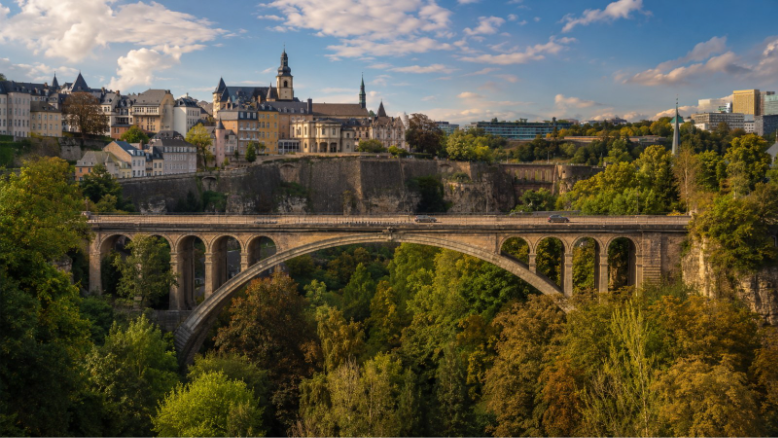
Luxembourg looks like the kind of place where a Bond film would begin.
The city rises in layers. Stone bridges stretch over deep green ravines. Glass buildings catch the light above medieval walls. Narrow streets bend into grand civic squares. There is a sense of secrecy, precision, wealth and history, all occupying the same compact space.
Walk through the city and you hear the same layering in language: French at one table, German at another, Luxembourgish in passing, English in business meetings, Portuguese and Italian woven through the streets.
It feels less like a small country than a crossroads.
That made it a fitting place for me to speak recently at the Transeo Summer Summit, hosted by the Luxembourg Chamber of Commerce, to a group of business owners, investors and entrepreneurs focused on buying and building companies. The people in the room were not merely interested in starting businesses. Most were focused on acquiring them, stewarding them, growing them and passing them forward.
That distinction matters.
We often celebrate the founder who begins with a blank sheet of paper. But another kind of entrepreneur deserves equal attention: the owner who acquires an existing business and asks, “How do I preserve what makes this company valuable while helping it become something more?”
And here we are not talking about private equity firms and buy and flip scaled enterprises. We are talking about sole entrepreneurs who inherit more than assets. They inherit relationships, employees, suppliers, customers, communities, obligations and trust.
In other words, they inherit stakeholders.
That word can make some business leaders uneasy. It is sometimes interpreted as a softer alternative to capitalism, or as a step toward bureaucracy, regulation or a welfare state. But my experience in Luxembourg suggested something different.
Stakeholder capitalism, properly understood, is not capitalism diluted. It is capitalism strengthened.
The question is not whether companies should make money. Of course they should. Profit is the oxygen of enterprise. Without it, companies cannot invest, hire, innovate or endure.
The better question is: What kind of system helps companies create profit that lasts?
For decades, many businesses have focused primarily on shareholders. That focus has created tremendous value. It has pushed companies to be more disciplined, efficient and accountable.
But every model has limits. When the time horizon gets too short, or when financial returns become separated from the people and communities that make those returns possible, companies can weaken the very foundations they depend on.
Who Gets a Vote in the Future of a Company?
Eric Ries, author of The Lean Startup and more recently Incorruptible, offers a useful way to think about this. One of his most provocative metaphors asks us to imagine a country where tourists can vote. They arrive, buy a passport, cast a vote that shapes the future of the country, and then leave. Imagine if my brief visit to Luxembourg coincided with an election and I could vote on the next prime minister.
That sounds strange in a nation. Yet something similar can happen in business when short-term investors influence a company without intending to remain connected to its long-term consequences.
Meanwhile, employees, suppliers, customers and communities often live with those consequences for years. Founders and long-term owners may care deeply about the mission, reputation and legacy of the business.
A stakeholder lens simply asks us to widen the frame.
It does not mean shareholders no longer matter. It means shareholders are more likely to benefit when the broader system that supports the company is healthy.
The Rhineland model of capitalism offers a useful counterpoint. Associated with Germany and parts of continental Europe, it combines market competition with stronger institutional support, long-term orientation, vocational systems, worker involvement and partnership among business, labor and government. It is not anti-market. It is a form of capitalism that recognizes that markets perform best when the institutions around them are strong.
Markets do not thrive in a vacuum. They thrive inside systems.
Government as Partner, Not Substitute
This is where Luxembourg became more than a beautiful backdrop. The Chamber of Commerce was not acting as a substitute for business. It was not trying to run companies or remove risk from entrepreneurs. It was convening, connecting, supporting and enabling them.
That is the kind of government partnership capitalism needs.
The right form of public support does not smother enterprise. It creates the conditions in which enterprise can perform at a higher level. It helps business owners access knowledge, networks, talent, capital and markets. It encourages continuity in ownership transitions. It supports the entrepreneurs who keep small and midsize companies alive rather than letting them disappear for lack of succession.
That is not welfare. That is infrastructure.
We easily recognize physical infrastructure: roads, ports, railways, airports, energy grids and broadband. But economies also depend on relational infrastructure: trusted institutions, chambers of commerce, apprenticeship programs, industry associations, financing networks, universities and public-private partnerships that help firms coordinate, learn and grow.
When those systems work, capitalism becomes more productive, not less.
Buying a Business Means Inheriting a System
This matters especially for business owners who buy other businesses. Acquisition is often discussed in financial language: multiples, leverage, synergies, integration, EBITDA growth. Those measures are important. But they are incomplete.
When you acquire a business, you are not only buying cash flow. You are entering a living system.
You are buying the trust customers have placed in the company. You are buying the knowledge employees carry in their hands and habits. You are buying the reputation the company has earned in its community. You are buying promises made by past owners, whether formally or informally.
If you treat the business only as a financial asset, you may improve the numbers for a while. But if you overlook the relationships that created those numbers, you may miss the real source of value.
A stakeholder lens helps the new owner ask better questions:
- What must remain unchanged for this company to keep its soul?
- Which relationships are essential to its advantage?
- What do employees know that the balance sheet cannot show?
- Where can government, industry groups or civic institutions help us create the next stage of growth?
- How do we improve the business without breaking the trust that made it worth buying?
This is not sentimental. It is strategic.
The most durable companies learn to align interests over time. They create value for owners because they create value with employees, customers, suppliers and communities.
Luxembourg seems to understand this instinctively. Perhaps it comes from being small, multilingual and deeply connected to surrounding economies. In a place where cultures, languages and institutions meet every day, partnership is not an abstract ideal. It is a practical necessity.
As I left the city, I kept thinking about those bridges.
Luxembourg’s beauty comes partly from its contrasts: old and new, stone and glass, local and global, fortress and marketplace. Its economy seems to carry a similar lesson. Capitalism does not need to choose between dynamism and responsibility. The strongest systems build bridges between them.
Business owners who buy and build companies have a special role to play in that future. They can become more than investors. They can become stewards of productive communities.
And governments, when they act as partners rather than substitutes, can help them do it.
That may be the real lesson from Luxembourg: capitalism shines brightest when the systems around it help enterprise endure.
Build business bridges that last by joining Outhinker today.