
Listen to an AI audio recording of this newsletter
The chief of staff to the CEO often functions as the chief strategy officer, whether the organization recognizes it or not.
This is not because the chief of staff necessarily owns strategic planning or carries the CSO title. It is because the role sits at the point where the CEO’s intentions must become organizational action, the bridge between vision and results.
The CEO establishes direction. The chief of staff translates that direction into priorities, decisions, communication and follow-through. The CSO is expected to do much the same.
Both roles close the distance between what the CEO wants the company to become and what the organization is prepared to do next. As I explored in a recent newsletter, the CSO must also work closely with the CFO to connect that direction to capital allocation, performance expectations, and the company’s financial narrative. But alignment with the CEO comes first. Without a shared understanding of the destination, even strong coordination can move the organization efficiently in the wrong direction.
Strategy Begins With Translation
CEOs rarely communicate strategy as a perfectly sequenced set of instructions. Direction emerges through conversations, operating reviews, customer meetings, board discussions, and decisions made under pressure.
Someone must connect those signals and translate them into a coherent system of action. That responsibility often falls to the chief of staff, a role many members of our Outthinker CSO network also hold. Once again, the title matters less than the role being played: ensuring that insight becomes coordinated action.
Both roles must understand not only what the CEO has decided, but why it matters, which tradeoffs the CEO is willing to make, and what cannot be lost as the idea moves through the organization. They must determine which decisions matter most, who needs to be involved, and what must change.
The work requires judgment, credibility and the ability to coordinate leaders who may each see only one part of the strategy.
Being in lockstep with the CEO does not mean agreeing reflexively. The chief of staff or CSO must surface risks, challenge assumptions and expose conflicts before they undermine execution. But once direction is set, the role is to make it understandable, actionable and durable across the enterprise.
The Title Matters Less Than the Work
The CSO role is still evolving, and its scope varies considerably among organizations.
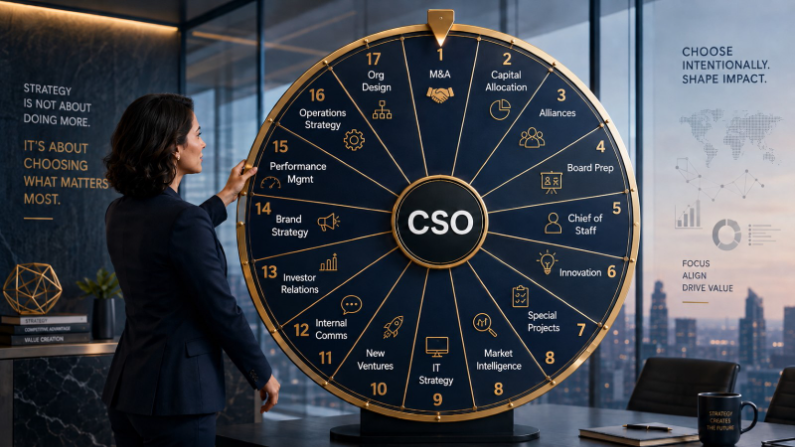
In some companies, the CSO concentrates on growth through M&A, alliances and business development. In others, the strategy office acts as an internal problem-solving group. Elsewhere, the emphasis is alignment through planning, communication, board preparation and performance management.
Our research has identified 18 responsibilities that may sit within a strategy office, including acting as chief of staff to the CEO, running innovation programs, incubating new businesses, managing KPIs, shaping operations strategy and coordinating board presentations. These responsibilities generally cluster around three mandates: growth, problem-solving and alignment.
No strategy office should attempt to own all of them.
The goal is to determine which capabilities the CEO and the organization need most. A company preparing for expansion may need a growth-oriented office. One confronting disruption may need a problem-solving team. An enterprise with weak coordination may need the CSO to concentrate on alignment.
The right design follows the strategic need, not the title.
Avoid the Office of Everything Else
Ambiguity gives a new CSO or chief of staff room to shape the role. It can also become dangerous.
Over time, the strategy office can become a holding area for whatever feels urgent, ambiguous or politically sensitive. Work gets handed to strategy because it crosses functions, lacks a clear owner or requires someone trusted by the CEO to resolve it.
The team stays busy. But busyness is not the same as strategic contribution.
When the chief of staff or CSO spends most of the day responding to the latest request and absorbing work that belongs elsewhere, the organization becomes increasingly reactive. Individual issues may get solved while the company quietly loses sight of its larger direction.
That is how strategic drift begins.
A strong strategy office protects the organization from that drift. It ensures that immediate demands do not displace the priorities the CEO has established. It connects decisions across functions, identifies when resources are moving away from strategic commitments and keeps execution tied to strategic intent.
This requires clarity about what the strategy office will do and what it will not do.
The chief of staff and CSO should focus on work that requires proximity to the CEO, coordination across the enterprise and a clear line of sight between direction and execution.
The strategy office is not where ownerless work should go.
It is the function that keeps all the organization’s work moving in the same direction.
Building the Strategy Office the CEO Needs
There is no single model for the ideal strategy office. There is only the model that best supports the CEO’s direction, the company’s priorities and its current stage of development.
That is why we are developing an upcoming series on how to build an effective strategy office.
We will examine the major roles a CSO may play, how to determine which ones your organization needs and how to define the office’s scope, capabilities and relationship with the CEO.
The first question is not whether the organization needs a chief of staff or a chief strategy officer.
It is whether someone is accountable for turning the CEO’s direction into coordinated movement.
In many companies, that is already the same job.
Build your strategy office and support your organization by joining Outthinker.com today.