
Listen to an AI audio recording of this newsletter
When companies talk about growth, they usually start by looking across the battlefield.
Who has the customers we want? What would persuade them to switch? How can we offer a better product, a lower price or a more compelling experience than our competitor?
It is logical. It is also limiting.
For an upcoming episode of the Outthinkers Podcast going live on September 22, I spoke with Ron Johnson, the retail executive who helped transform Target and later worked with Steve Jobs to create the Apple Store. Our conversation surfaced a powerful strategic lesson: sometimes the largest market is not your competitor’s customers at all. It is the people who are not buying from anyone.
Stop fighting for the market you lost
When Johnson joined Apple around 2000, the company faced an obvious strategic problem. Microsoft Windows dominated personal computing. Apple needed more people to choose the Mac.
The conventional answer was to convert PC users.
Johnson saw another possibility. At the time, he recalls, only about half of Americans were using computers at all. Instead of focusing entirely on persuading Windows users to switch, why not focus on the people who had yet to choose any computer?
As Johnson told me: “Why are you worried about winning share from Microsoft? Go after the other half.”
It was a deceptively simple reframing.
Apple could continue fighting Microsoft over people who already had established preferences, habits and expectations. Or it could focus on the millions of people who had yet to enter the category.
This is the strategic opportunity of nonconsumption. Companies naturally define their markets by the customers already participating in them. But noncustomers can represent an enormous, largely uncontested pool of growth.
I heard a remarkably similar idea in an earlier Outthinker Podcast with Ajay Banga, former CEO of Mastercard and now president of the World Bank Group.
Early in his tenure as CEO, Banga made a simple strategic shift: Mastercard would stop defining other electronic payment systems as its primary competition.
“We … pivoted the company early in my time as CEO into focusing on cash as the enemy, not other electronic payments systems,” he told me.
The math made the opportunity clear. At the time, Banga says, roughly 85% of the world’s retail transactions were still conducted in cash. Instead of fighting primarily for a larger piece of the relatively small electronic-payments market, Mastercard could help make the entire market larger.
That shift pushed Mastercard toward new customers and partners. If the objective was to displace cash, large banks alone were not enough. Mastercard needed small banks, governments, transit operators, mobile-phone companies, merchants and technology companies.
Apple and Mastercard were asking versions of the same question: Why fight harder over the customers already in the market when an even larger opportunity may exist outside it?
Meet noncustomers where they are
Identifying noncustomers is not enough. You have to understand what keeps them from becoming customers.
For Apple, Johnson believed the barrier was fear.
“The challenge we had to overcome wasn’t to show what the Mac could do,” Johnson told me. “The most important thing was to overcome their fear of technology.”
That insight changed the store.
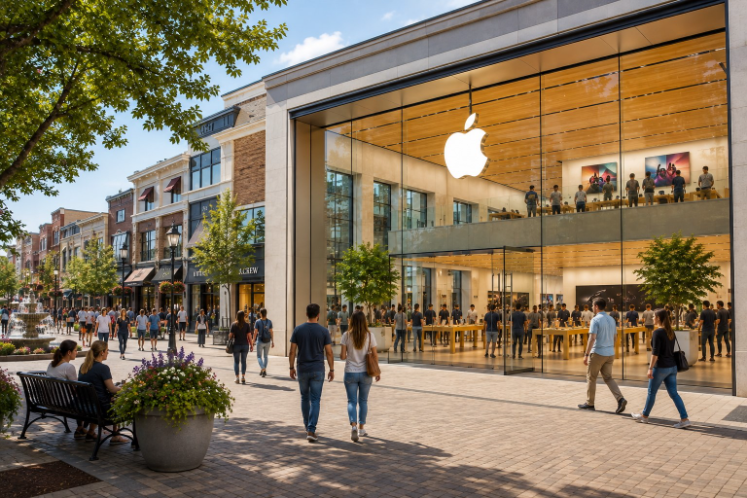
Computer retailers typically occupied destination locations. Apple went into busy malls. The logic was simple: why ask someone already hesitant about computers to drive 10 miles to investigate one?
That was almost literally how Jobs came to see it. Johnson recalls Jobs realizing that a mall location meant getting that unsure consumer to walk just 10 feet out of their way.
But location only got people to the door. The store had to make them want to walk inside.
Design for discovery
Apple had so few products that Johnson recalls they could fit on a conference-room table. Conventional retail logic would have dictated a small store.
Instead, Apple built stores of roughly 6,000 square feet.
The space wasn’t for inventory. It was for experience.
Johnson describes the result as an open, beautiful space with tables and plenty of products available to try. People could walk in, touch a Mac and experiment with it.
“This is our first impression people are going to have of Apple,” Johnson told me. “It used to be a product, now it’s going to be a store.”
That distinction matters.
Apple wasn’t designing a store only for people who had decided to buy a computer. It was creating a place where people who were curious about technology could encounter it without having to commit to it.
Come in. Touch it. Play with it. Ask a question. Come back.
For an experienced computer buyer, that might have seemed unnecessary. For someone intimidated by technology, it lowered the stakes of the entire experience.
Apple turned shopping for a computer from a high-consideration destination purchase into something you could discover while walking through the mall.
Reduce fear, increase adoption
Then came the Genius Bar.
Johnson noticed that technology retailers often hid service and repairs. Problems happened behind glass or behind closed doors, away from prospective customers.
But consider that from the perspective of the noncustomer Apple wanted to reach.
One of their biggest fears was obvious: What happens when I can’t figure this thing out?
Hiding technical support reinforced that fear. Apple did the opposite.
Johnson envisioned a bar in the middle of the store staffed by knowledgeable people who could answer questions whenever the store was open. Customers could see the help before they ever needed it.
“We took what was the problem area for most stores that they’d hide,” Johnson recalls, “and we stuck it out and made it a big deal.”
Apple made a similar choice about its employees. Rather than rely exclusively on commissioned technology experts, Johnson says the company hired teachers, firefighters, people from bookstores, and young people customers could relate to.
And in another break from business as usual, Johnson decided not to pay sales commissions. Apple wanted its people helping, not selling.
That distinction mattered. The goal was not to maximize the odds of a transaction on each visit. It was to make customers comfortable enough to explore, learn, ask questions and come back.
The pieces reinforced one another. Location reduced the effort required to encounter Apple. The store reduced the pressure to explore it. The Genius Bar reduced the perceived risk of owning it. The no-commission model reduced the pressure to buy.
Each choice strengthened the others. Apple was not building a single advantage. It was digging a moat around a moat around a moat, making the experience increasingly difficult for traditional retailers to copy.
Each choice attacked the same barrier: fear of technology.
Find the market no one owns
Leaders spend enormous amounts of time studying competitors. They benchmark their products, prices and customer experiences, then look for ways to be better.
That can produce market-share gains. It rarely changes the game.
A more interesting strategic exercise begins outside the existing market.
Who isn’t buying? Who assumes your category is too expensive, complicated, inconvenient or risky? Who could benefit from what you offer but does not yet believe it is for them?
Then ask the question that matters most: What is keeping them out?
Sometimes the barrier is knowledge or confidence, as it was for Apple’s target customers. Sometimes it is price, or simply the perception that something is unaffordable. Sometimes it is access.
Once you identify that barrier, strategy becomes the work of systematically removing it.
Johnson’s definition of strategy is useful here. Strategy, he told me, is not strategic planning. It is doing something that creates a “step change” and permanently changes the trajectory of the business.
Apple didn’t simply build a better place to sell Macs. It designed an experience around people who weren’t yet buying computers.
Mastercard didn’t simply try to take another transaction from Visa. It expanded its competitive frame to the vast number of transactions still happening in cash by advancing financial inclusion.
The opportunity gets bigger when you stop defining your market by the customers already in it.
Sometimes the biggest growth opportunity isn’t beating your competitor.
It’s creating the customer neither of you has yet.
Join Outthinker today to discover the opportunities your competitors aren’t chasing and turn overlooked markets into your next source of growth.