
AI is rapidly commoditizing information.
If you want 30 strategic options, five market maps, a competitor teardown, a pricing hypothesis, and a set of board-ready slides, then you can get it in minutes. Strategy is becoming faster, cheaper, and more available than at any point in history.
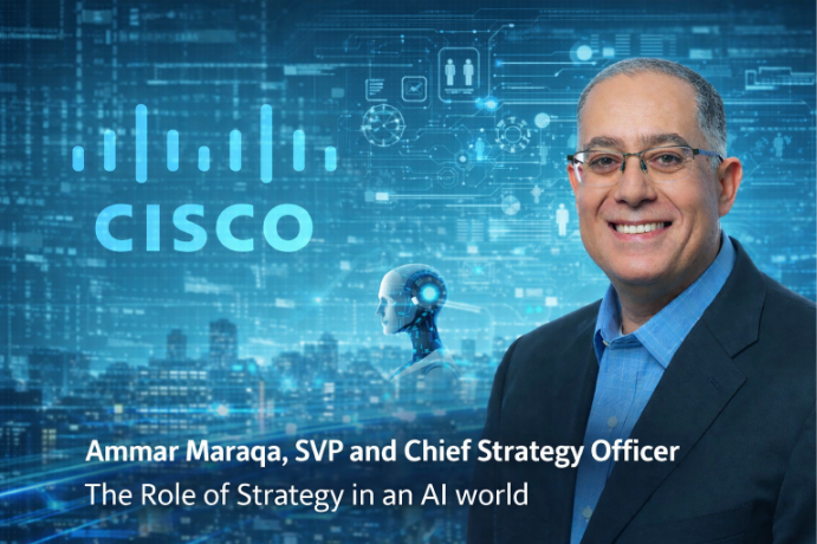
And yet, after interviewing Ammar Maraqa, Cisco’s Chief Strategy Officer (and the former strategy leader who helped scale Splunk from roughly $300M to $5B), I’m more convinced than ever that AI will be a tailwind, not a replacement engine.
Because strategy isn’t just about ideas.
It’s about belief, institutional context, cultural sensitivity, and accountability — the very things AI cannot carry.
Ammar said something that captures this perfectly. He framed the sign of a strong strategy office as a pull model, not a push model:
“You’re successful when it’s a pull model versus a push model … The pull model is where people are coming to you because of your expertise … The sign of a successful strategy team … is there a pull for that team versus you’re constantly trying to push your way and getting credibility at that table.”
That one distinction — pull vs. push — contains an entire strategy philosophy. And it’s the philosophy Cisco is building into its operating infrastructure as AI accelerates everything except execution.
AI Gives Answers, Not Ownership
AI can produce:
- ideas
- frameworks
- summaries
- benchmarks
- “best practices”
- scenario options
But AI cannot:
- anticipate your organization’s cultural sensitivities
- understand legacy decisions
- internalize your institutional constraints
- create meaning that motivates people
- stand behind a trade-off when it hurts
- be accountable when the strategy fails
AI has no career risk. AI has no stake. AI has no reputation on the line.
Humans do.
And that’s why the decision seat, especially in enterprise strategy, does not get automated away. If anything, it becomes more valuable.
Because as AI floods the world with “good answers,” the scarce capability becomes the ability to discern: which answer fits this organization, this culture, this moment, and which answer is merely plausible.
Ammar puts it in the most practical definition of strategy I’ve heard in a while: “The simplest definition of strategy is it’s how you allocate your resources.”
That’s the key. Allocation requires judgment. Allocation requires trade-offs. Allocation requires a person, or a leadership team, who can say: we chose this, and we own it.
Scaling Logic
Earlier in his career, Ammar learned how fragile growth becomes when focus and execution fall out of sync. Scaling required forcing coherence across product, go-to-market, and customer success while narrowing attention to a small number of buyers and use cases that could be served repeatedly and profitably.
The operating insight was simple: fragmentation kills scale. Strategy only works when there is an unbroken line from what gets built to how it gets sold to why customers renew.
At Cisco, the context is radically different.
This is not a company choosing between two buyers or executing a clean SaaS transition. Cisco is a global, multi-business enterprise spanning infrastructure, software, security, observability, channels, and an enormous installed base. Complexity is not a phase — it is the operating condition.
So Ammar applies the same underlying logic — focus, coherence, and execution discipline — but translates it into something that can organize an entire corporation: customer problems rather than product categories.
Cisco now frames its strategy around three enterprise-level customer imperatives:
- AI-ready data centers
- Future-proofed workplaces
- Digital resilience
These are not marketing themes. They function as strategic organizing principles — concentrating investment, guiding M&A, shaping roadmaps, and aligning go-to-market motions across dozens of product lines.
This is what buyer discipline looks like when scaled to a $50B enterprise: not fewer offerings, but a small number of customer problems powerful enough to impose order on complexity.
CLV and the Customer Problem Lens
Here’s the scaling truth many companies miss:
You can grow with products.
But you scale with problems.
Products proliferate. Problems organize.
When Cisco frames its strategy around “AI-ready data centers” or “digital resilience,” it is doing what Splunk did at a smaller scale: anchoring on urgent, persistent customer outcomes.
Ammar’s “digital resilience” explanation is as close to a CEO-grade truth as it gets:
“If you’re a CEO … your systems go down … you really only care about getting it up and running. You don’t care whether it’s a security incident … or a system outage.”
That’s the point. Customers don’t buy categories. They buy relief from failure.
If you want to scale an organization, you must build an enterprise around problems customers cannot afford to ignore.
Cisco: Strategy IS Infrastructure
At Cisco, scaling requires making strategy operational across an enormous system.
Ammar describes the modern Cisco strategy office as an integrated machine, not a planning department:
“You have the strategy team … the M&A and investment team … the Office of the CEO team … the QBRs … metrics, the KPIs … it gives the strategy a lot of teeth. And then … incubation.”
This is what I mean when I say strategy becomes foundation and infrastructure.
Not the deck. Not the narrative. Not the annual planning ritual.
Infrastructure:
- agenda control (what gets discussed, measured, reviewed)
- capital allocation (build/buy/partner/incubate)
- organizational pull (leaders demanding strategy support rather than tolerating it)
And notice how Cisco’s historical M&A culture fits this model. Ammar describes Cisco’s long-standing advantage as treating the startup ecosystem as an extension of R&D: “We thought of the market … and the startup ecosystem as an extension of our own R&D … it became part of the culture.”
Culture matters. AI can’t copy-paste culture. AI can suggest a build/buy/partner matrix.
But it cannot embed the decision habit into every GM.
Push vs Pull: One is Scalable Strategy
Let’s define it plainly.
Organizational Push
A push model is when a strategy function must insert itself into the business.
What it looks like:
- Strategy schedules reviews, audits, “check-ins”
- Teams present strategy for approval
- Strategy generates frameworks, decks, recommendations
- Adoption depends on persuasion, authority, escalation
Underlying dynamic: strategy is treated as an external evaluator.
Hidden cost:
- leaders comply but don’t commit
- execution is superficial
- strategy becomes performative rather than operational
This is what Ammar critiques as “strategy police.”
Organizational Pull
A pull model is when business leaders seek out strategy because it helps them win.
What it looks like:
- leaders ask strategy to clarify trade-offs
- strategy is invited into decisions before they harden
- teams use strategy to allocate resources, not just justify them
- accountability is shared, because the business owned the ask
Pull models create accountability because the business can’t say, “Strategy made me do it.”
They say, “We chose this and we own the outcome.”
That is why pull scales. Push doesn’t.
“In an AI-saturated world, push models will get worse because producing ‘more strategy content’ is now cheap. The scarce thing is decision ownership.”— Ammar Maraqa
The Real Decision Makers
As AI becomes a strategy engine, we still need people in the decision-making place because people have agency.
Agency is the gateway to accountability.
And accountability is the gateway to execution.
AI can’t inspire a sales leader to go to war for a new motion. It can’t create shared conviction across an executive team. It can’t absorb the political cost of reallocating capital away from legacy power centers. And it can’t be held responsible when a bet fails.
Humans can and teams can do it even better.
Group decisions create shared accountability that AI cannot replicate. When leadership teams align on a direction, and commit to resource allocation, execution becomes possible.
Which brings us back to Ammar’s most repeatable strategic filter: “Attractiveness versus ability to execute.”
AI will help us see attractiveness faster than ever.
But “ability to execute” is about institutional muscle: go-to-market readiness, talent, incentives, culture, credibility, and the steel thread that keeps the system coherent.
That muscle is built by leaders, not generated by models.
In other words: human judgment and experience are not being replaced. They’re being repositioned as the differentiator.
That’s the pivot.
And Cisco is a living example of why it matters. Ammar didn’t just bring “strategy.” Cisco’s complexity: customer-problem focus, steel-thread coherence, and strategy-as-infrastructure are all delivered through a pull model that creates accountability.
AI will accelerate strategy work. But humans will still decide what to believe, what to fund, and what to own.
That’s not a limitation of AI.
That’s the point of strategy.
To learn more about the future of AI in professional services, or to innovate with strategic peers, join us at this year’s Outthinker Summit on February 24 in Miami, FL.