
Listen to an AI audio recording of this newsletter
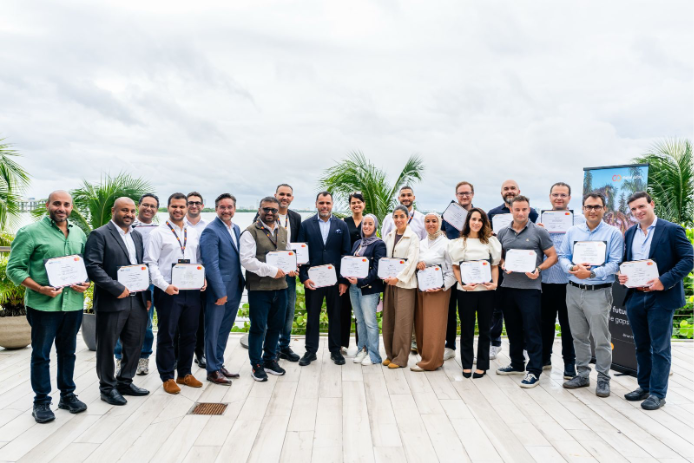
Seventeen senior banking and payments executives from across Saudi Arabia, Egypt, Jordan, and Bahrain came together in Miami for three days with Mastercard.
The goal was not to sit through another conference.
It was to get close to what is actually changing in banking, hear directly from experts shaping those changes, challenge assumptions, and leave with ideas worth acting on.
I was thrilled when Mastercard asked Outthinker to help design and facilitate the experience.
My team and I had a great time thinking through the mix of speakers, conversations, and experiences that would make the most of three days. We brought in experts from academia, fintech, AI, payments, and the Miami innovation community.
We spent time at the University of Miami. We explored the future of payments and digital banking. And on the final day, we moved from learning to doing.
I was especially grateful to the experts who gave the summit its depth: Nick Tsinoremas, Indraneel Chakraborty, Chris Huff, Anthony Vigliotti, Guida Sousa, Eric Rosenthal, Jairo Riveros, Dr. Junaid Ward, Alix Charlier, and Melissa Medina. Each brought a distinct perspective on where banking, AI, payments, and innovation are headed.
Mastercard deserves enormous credit for creating the kind of environment where senior leaders could do more than listen. They could question, connect, debate, and leave with ideas they could actually use.
That matters because there is enormous value in simply being in the room.
When you put leaders with different experiences and assumptions together, something happens that is difficult to recreate through reports, podcasts, or presentations alone. One idea starts colliding with another.
And over three days, a few connections became hard to ignore.
AI Isn’t the Strategy
AI came up constantly, of course.
But the more we discussed it, the less interesting the model itself became.
During his presentation, Tsinoremas made the point that as institutions gain access to increasingly similar models, advantage moves elsewhere: into orchestration, workflow, judgment, and governance.
That distinction matters. If everyone can access powerful AI, then simply having the technology does not create much separation. The real advantage comes from how well an organization integrates it into the way decisions are made, how clearly people understand when to trust it, and how effectively humans and machines work together.
Chakraborty then pushed that thinking into banking strategy. The edge is not simply having AI. It is constructing the flywheel between data, insight, decisions, customer relationships, and learning.
In other words, a competitor can access a model that may generate an answer, but building the machine that turns that answer into action is hard to emulate. It has to connect the right data, apply judgment, learn from the outcome, and feed that learning back into the next decision.
That is where the conversation started to feel less like a technology discussion and more like a strategy discussion.
The question shifts from: What AI should we use?
To: What are we now able to do differently because AI exists?
And then one step further: What can we now do better, faster, or more intelligently than competitors who have access to the same tools?
That is a much harder question. It is also where the real competitive advantage begins.
The Customer Relationship is Changing
Another conversation kept returning to the same idea: banking is moving beyond products.
Chakraborty said it simply: “Banks are not for products, but for lifestyle.”
Customers are not looking for a mortgage. They want a home.
They are not looking for a payment rail. They want money to arrive.
They are not looking for another app feature. They want the problem solved.
Sousa advanced the idea further. As digital experiences shift from menus toward agents, financial institutions may eventually have to serve not only the customer, but the intelligence acting on that customer’s behalf.
That idea created real debate in the room.
Helping a customer decide is one thing.
Making the decision for them is another.
That tension may be one of the most important places to watch.
The Opportunity Is in the Gaps
While speaking to the audience, Rosenthal gave us one of the most memorable lines of the week: “Your payment rails leapfrogged. Your back office did not.”
Banks have added faster rails, more platforms, more partners, and more sophisticated capabilities.
But every new layer also creates more connections that have to work. More systems that your back-office staff has to query. More information has to move cleanly between teams, platforms, and partners. And when something breaks, someone still has to understand where the problem sits.
That tied directly to what we heard from attendees from Paysend around interoperability and, later, to one of the strategy lenses we used in the Outthinker workshop:
Coordinate the uncoordinated.
It is easy to assume the next breakthrough requires another new technology, platform, or product.
Sometimes it does.
But sometimes the bigger opportunity is hiding in the gaps between what already exists.
The competitive advantage may come from seeing those gaps earlier, connecting the pieces more intelligently, and creating a smoother system than everyone else.
Sometimes the opportunity is not to invent another piece.
It is to see how the pieces could work together differently.
Turn Insight into Action
On the third day, we asked participants to take everything they had heard and turn it into strategic options for their own institutions.
Using our IDEAS framework—a five-step strategic process designed to challenge conventional thinking—and the 9 Ps framework, they rethought assumptions, generated alternatives, and identified ideas outside the obvious choices that could create meaningful competitive advantage.
That, for me, was the most important part of the week.
The value of an experience like this is not the number of ideas you hear.
It is whether you leave seeing your own choices differently.
At Outthinker, that is what we try to create: the right room, the right people, the right questions, and enough distance from the everyday to see possibilities that were harder to see before.
Because seeing the future is useful.
Seeing the options others miss is where competitive advantage begins.
Join Outthinker today to get in the right room, at the right time, and make the right moves.