
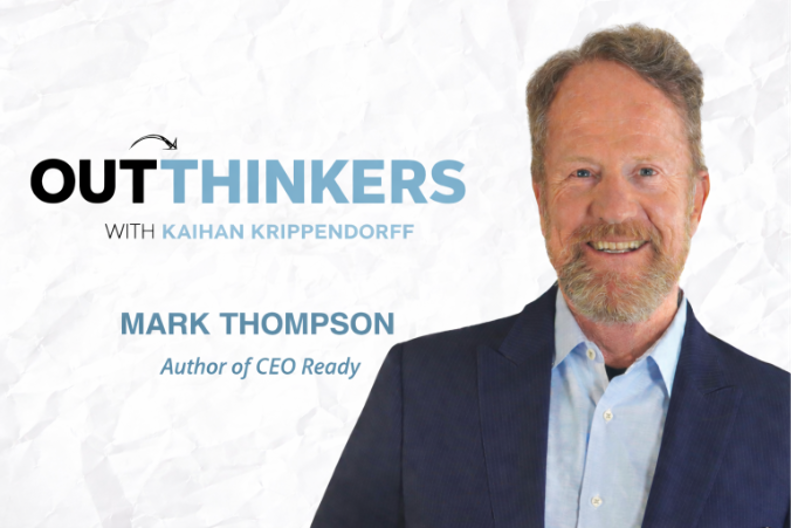
In hosting the Outthinkers podcast, I get to speak with some of the world’s most strategic minds. But few conversations have reshaped my own understanding of leadership the way my recent dialogue with Mark Thompson did. Mark is a CEO coach to many of the world’s highest-performing executives and author of the newly released CEO Ready.
Listen to my podcast with Mark Thompson
I came into the conversation expecting insights about becoming a successful CEO, about boards, succession, or executive performance. What I walked away with was much deeper: a clearer understanding of how the CEO drives a company’s scaling not by being the smartest person in the room, but by earning the belief and alignment of seven very different stakeholder groups.
As Mark told me, “Strategy is the set of courageous choices about where to play, how to win, and who has to believe in you in order to win the job.”
That last clause — who has to believe in you — is what separates good strategists from enterprise-level leaders. The CEO job (and really any senior role) isn’t won through achievement alone. It is won through alignment.
Your Track Record Only Gets You Halfway
Like many of you, I’ve always believed that delivering strong results creates upward opportunity. But Mark explained that this logic breaks down right at the top.
When a leader reaches the shortlist for CEO, everyone under consideration is already a top performer. Performance is the ticket into the room, not the determinant of who ultimately gets the nod.
Mark put it plainly: “You have to earn readiness twice … you’ve been delivering for decades, but you still have to win hearts and minds in a new way, outside your swim lane.”
This hit me hard. At the highest level, your past becomes table stakes. The differentiator becomes whether you can generate belief across the organization’s full ecosystem.
The Seven Stakeholders That Must Align
What I found most compelling in Mark’s framework is the clarity it brings. We often think about the board and shareholders, but Mark identifies seven distinct stakeholder groups that must be aligned for a CEO to succeed at enterprise scale. Many leaders unconsciously ignore several of them.
Whether you aspire to the CEO role or simply want to strengthen your strategic influence, concentrating on these seven stakeholder groups will help you execute strategy at scale through alignment, influence, and winning the hearts and minds of others.
1. The Board: 12 People, 12 Lenses
I’ve often thought of “the board” as a single body. But Mark reminded me that a CEO effectively has as many bosses as there are board members.
“Everyone around the table has a different point of view,” he explained. “They all have their own scar tissue that informs what they see.”
Boards today are composed of subject matter experts, such as former CEOs, finance leaders, scientists, and HR chiefs. Each brings a lifetime of lessons. To lead at the highest level, you need to understand their backgrounds, histories, and personal biases.
This requires shifting your aperture from narrow functional mastery to broad organizational awareness.
2. Shareholders: The People Who Actually Own the Place
One of Mark’s lines that stuck with me was: “As a candidate, remember: the owners own it. Treat them like they own the place.”
He walked me through how expectations evolve dramatically depending on whether the company is venture-backed, private-equity-owned, or public. The KPIs investors value change with each stage.
Mark’s advice for anyone aspiring to senior leadership:
- Attend every analyst call.
- Read every investor letter.
- Study analysts’ critiques.
- “Write your own activist letter” to clarify your strategic point of view.
This is how strategists build an enterprise-level lens.
3. Peers: The Colleagues Who Can Make or Break You
One of the most surprising truths: Peers don’t pick you, but they can get you fired.
Mark described how peers may admire and enjoy working with you, yet still struggle to see you as “the boss.” That’s why rising leaders must demonstrate generosity, collaboration, and cross-functional fluency, long before a succession conversation begins.
Mark gave an example in which a hard-charging divisional leader shifted perceptions simply by riding along with peers, asking questions, and listening. It disarmed people. It signaled enterprise-first thinking.
“The quickest way to lose interest is to stay a subject matter expert. You must widen your aperture.” — Mark Thompson
4. Employees: The Monthly Vote of Confidence
Engagement tools now give boards and executives unprecedented insight into employee sentiment. Staff members are not in the boardroom, but their voices are.
If employees don’t believe in you, your tenure is fragile. And if you can win them early, you build the foundation for strategy execution through others, not through authority.
5. Customers: From Buyers to Strategic Partners
I loved Mark’s framing on customers. He said, “Nothing happens unless customers are repeat customers. Start thinking of them as partners.”
In an environment where industries are being disrupted, CEOs, and those preparing for senior roles, must spend real time with customers. Not just during sales calls, but through field visits, shadowing, co-innovation, and informal learning.
Customers shape strategy, whether they’re physically present in the boardroom or not.
6. The Current CEO: A Human Being With a Legacy
One stakeholder I had not considered enough before this conversation is the incumbent CEO.
Mark described how deeply emotional this transition can be, based on his own experience as incumbent CEO: “It felt like cutting my arm off … this is who I am.”
Leaders aspiring to the top must understand the psychology of legacy. Helping the current CEO shape their post-CEO identity builds trust and reduces unconscious resistance. Succession is not just operational — it is intensely personal.
7. You: The Most Overlooked Stakeholder
The final gatekeeper is yourself.
Many brilliant executives ultimately choose not to pursue CEO roles. Some prefer the work of CFO, CTO, or Chief Scientist. Mark shared stories of leaders, like Genentech’s Art Levinson, who initially turned down the CEO role because their identity was tied to doing the work they loved.
The question is not only, “Can I do the job?” but “Do I want the life that comes with it?”
Executing Strategy Through Others
One of the most important ideas I took from our conversation is this: The technically correct strategy is worthless if stakeholders won’t support it.
Mark said it beautifully: “The right answer isn’t the right answer unless it gets all the stakeholders aligned and gives you the right to execute.”
Strategy execution is not mechanical. It is emotional, relational, and political. It is about belief.
What Leaders Should Consider
After my discussion with Mark, I’m thinking differently about how leaders rise, and how they scale strategy across large organizations.
Here are the questions I believe every leader should ask:
- Am I widening my aperture beyond my function? Do the board, peers, and employees see me as enterprise-minded?
- Am I proactively aligning all seven stakeholders? Or am I unconsciously ignoring several of them?
- Am I executing through others or still through myself? Enterprise-scale strategy requires influence, not effort.
- Do I understand the motivations and fears of each group? Strategy is a conversation with multiple audiences.
- Am I cultivating belief or just crafting plans? Strategy becomes real only when people believe in it.
Create the Right Conditions
My conversation with Mark reminded me that leadership is not about having all the answers. It’s about creating the conditions in which the right answers can win.
Whether you aspire to be CEO or simply want to elevate your strategic impact, focusing on these seven stakeholders will help you execute strategy at scale, through alignment, influence, and the hearts and minds of others.
Learn how to build alignment and strengthen your position by joining us for the Outthinker Miami Summit on Feb. 24.